Tuesday, February 9, 2021

BBC 2011: Lesbos

By the end of May 2011 Steve was back in the fold, but Dick was still dragging his feet - so we had a three-quarters full BBC trip to the Greek island of Lesbos off the coast of Turkey. 
The Greek philosopher Aristotle landed here in 345BC, and began collecting and studying sea life in the central lagoon - then known as the euripus of Pyrrha. He stayed for two years, in which time and he made anatomical analyses to classify organisms and to explain how they functioned and reproduced - which he recorded in many books. His conclusions were mostly wrong and, despite observing variation in organisms, he believed life was immutable (though not created by a god). However, he could claim the title of the world's first biologist - and he initiated scientific methodology by expounding the need to observe, examine and hypothesize to understand the world.
The lagoon is still there, hosting a flock of flamingos, but it is now called the Kalloni Gulf.
Sea life is still abundant.
Greece is often associated with arid landscapes - as most tourists visit the south in the height of the hot summer - but Lesbos in Spring is a verdant paradise, alive with brightly coloured flowers and running water.
This may look like the flower of a tree, but it is a group of Thaumetopoea solitaria moth caterpillars - first described in 1838 by the German entomologist Christian Friedrich Freyer. They clump together, forming a furry mass with their long white hairs. They are mainly found in Turkey and the Middle East, where they feed on Pistacia trees - on Lesbos it is P. atlantica (the Mt. Atlas Mastic, Persian Turpentine or Wild Pistachio Tree) which occurs from North Africa to Iran. (The Pistachio nut tree from Central Asia and the Middle East is P. vera).
Fresh water and plants may not attract tourists, but they provide great habitats for other animals. A Western Yellow Wagtail (Motacilla flava) patrols the shore - it is the feldegg sub-species, the Black-headed Wagtail, which breeds from the Balkans to Afghanistan.
A Black Stork (Ciconia nigra), back from winter migration to central Africa, searches for fish.
The elegant Wood Sandpiper (Tringa glareola), on its way from Africa to the sub-arctic wetlands to breed. Tringa is a latin version of the Ancient Greek 'Tungas' - as mentioned by Aristotle.
And a truly spectacular sight - a flock of Curlew Sandpipers (Calidris ferruginea). They too are on Spring migration, but hear this: they breed in the arctic circle, in the far north of Siberia, but may spend the winter as far south as South Africa or even Tasmania! As if that wasn't enough, in the breeding season their plumage changes from a light grey to a deep red - and here you can see they already in that transition.
Cretzschmar's Bunting (Emberiza caesia) breeds from Greece to the Levant, and overwinters in the Sudan. It is named after the German physician and scientist Philipp Jakob Cretzschmar, who founded the Senckenberg Natural History Society in Frankfurt in 1817 - now the second largest natural history museum in Germany.
We searched the woodlands of Turkish pines (Pinus brutia) for Krüper's Nuthatch (Sitta krueperi), and were successful. It is found in Turkey and through the Caucasus to Russia. It was named at the end of the 19th century by the Austrian ornithologist August von Pelzeln after the German naturalist Theodor Johannes Krüper, who became curator of the zoological collection of the natural history museum in Athens.
Obligingly posing by the roadside, an Eastern Black-eared Wheatear (Oenanthe melanoleuca), now separated from the Western Black-eared Wheatear (O. hispanica) - the two meeting in central Italy.
Also using a man-made structure as a perch, a Little Owl (Athene noctua).
But the prize owl was this Scops Owl (Otus scops), suspiciously eying us from the safety of its tree roost in a car park - it is not surprising that skopos is Ancient Greek for 'watcher'.
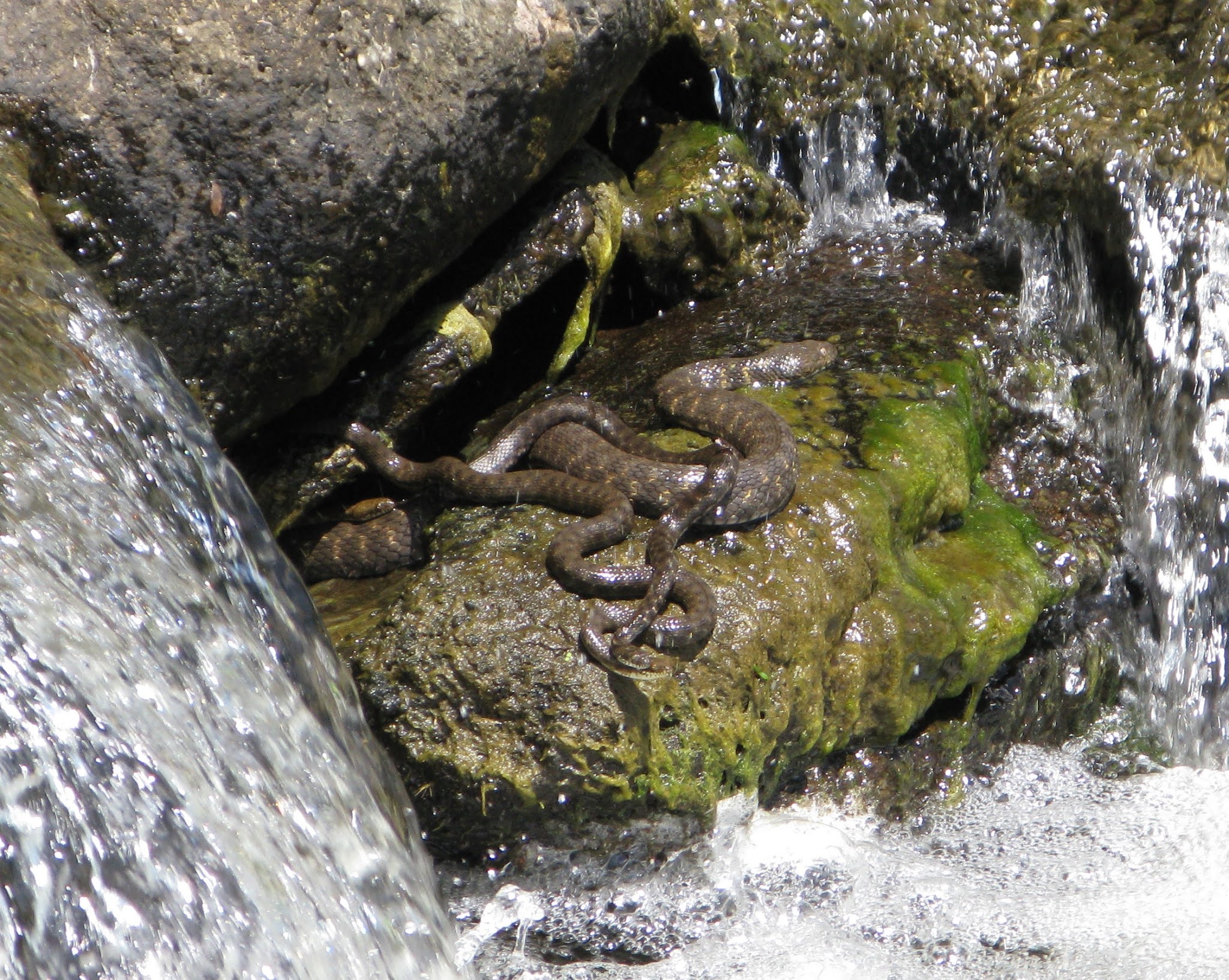
Also enjoying the Spring water, four Dice Snakes (Natrix tessellata) - otherwise known as Tessellated Water Snakes - which have found a perfect platform to hang out on as a base to hunt for fish. They are found from Italy to Central Asia.
This Sheltopusik (Pseudopus apodus) - or Glass Lizard - also found from Italy to Central Asia, was less lucky when out on the open road. Its name comes from the Russian for 'yellow-bellied'.
Another reptile happy in water is the Caspian Turtle (Mauremys caspica), found from the Balkans to central Asia. This is the sub-species M. c. rivulata, the Western Caspian Turtle. The young will need to watch out for the Black Storks!
The landlubber cousin of the turtle is the Greek or Spur-thighed Tortoise (Testudo graeca), found all over the Mediterranean along with four other species of tortoise. They live for much longer than humans, and it is highly likely that there are tortoises on Lesbos which were alive to see it under Turkish rule at the beginning of the 20th century. Indeed, they belong to the Turkish sub-species T. g. ibera.
Most lizards are not so dependent on water. This is a Snake-eyed Lizard (Ophisops elegans), found from the Mediterranean to Central Asia. The sub-species on Lesbos is O. e. ehrenbergi.
This immature Balkan Green Lizard (Lacerta trilineata), as the name suggests, has three beautiful green stripes on its back. Yet the adults are even more impreesive, being bright green with bright blue cheeks. It is found from the Balkans to the Middle East.
Starred Agamas (Stellagama stellio) can commonly be seen sitting on top of rocks from Greece to the Middle East. 
And when back in our rooms after sunset, Mediterranean House Geckos (Hemidactylus turcicus) kept us company. 
My blogs may give the impression that birding is fun and easy - that you just walk around, and species appear in front of you. This is not the case, and often we have to spend hours patiently looking out to sea in the hope of seeing a bird fly across the water.
We saw around 80 species of birds on Lesbos. Other birds of note were those which are mainly found in the eastern Mediterranean: Yelkouan Shearwater, Eleonoras's Falcon, Masked Shrike, Olive-tree Warbler and Eastern sub-alpine Warbler.

BBC - walking in the footsteps of giants.

Sunday, February 7, 2021

BBC 2010: Oman

In 2010 Steve and Dick frittered away too much time on work and families, and didn't find time to join the BBC trip - in November Mike and I left the Swiss winter to fly to the coasts and deserts of Oman.
It was the first BBC trip outside of the Palearctic geographic realm - one of six areas of common biology defined by the WWF, which extends from Portugal to Japan, and from Scandinavia and Siberia to North Africa, the Middle East and Central Asia. Oman is in the Afrotropical realm, with the Palearctic to the north and the Indomalayan realm on the opposite side of the Gulf of Oman - it is at a unique meeting point of three realms, and promises a diverse array of bird species.
We flew to the capital Muscat on the northern coast, and drove to Salalah in the far south on the border with Yemen.
We first drove along the coast down to the peninsula of Barr Al Hikman. On the rocks we saw Grapsus Shore Crabs, the same genus I saw in the Canary Islands last year only a different species - G. albolineatus.
Lesser Black-backed Gulls (Larus fuscus) were common along the shores. A number of 'forms' of this gull are recognized breeding across the north of the Palearctic from Portugal to Siberia, and there are discussions over whether some are sub-species or even species. The winter visitors we saw were most likely heuglini ('Siberian Gull') or cachinnans ('Caspian Gull').
The dark gulls pictured here amongst the Lesser Black-backed, with white necks and bluish bills, are Sooty Gulls (Ichthyaetus hemprichii) - common residents from east Africa to India, which can be the only gulls seen in Oman in summer. The latin name was given in honour of the German naturalist Wilhelm Friedrich Hemprich, who went on expeditions to north-east African, Arabia and the Levant and died of fever in the Eritrean port of Massawa. The yellow-billed terns are Crested Terns - more likely Greater (Thalasseus bergii) than Lesser (T. bengalensis), though we saw both. They are common throughout the year on the coasts from South Africa to Australia.
Another common winter visitor, the Eurasian Whimbrel (Numenius Phaeopus). Five sub-species are recognised breeding from Greenland to Siberia - I don't know which one has turned up here.
Squacco Herons (Ardeola ralloides) visit in winter from Africa, Europe and central Asia. However,  Indian Pond Herons (Ardeola grayii) also visit from east Asia - and they are very difficult to tell apart when not in summer breeding plumage.
The Red-wattled Lapwing (Vanellus indicus) is resident from Arabia to South-east Asia. In Oman, it is the aigneri sub-species, which extends east to Pakistan.
Other waders that fly south to take a winter holiday break in Oman are the Redshank (Tringa totanus) and the Greenshank (T. nebularia). Which species is which should be obvious, as shank is an old Eglish word for leg (or shin) - as applied to the tall King Edward I of England, Edward 'Longshanks'.
They are joined by the Dunlin (Calidris alpina) - 'dun' meaning dull brown in old English. This is most probably alpina, one of 10 sub-species, which breeds from Scandianavia to Siberia.
Driving inland into the deserts we saw Green Bee-eaters (Merops orientalis), first described by the 18th century British ornithologist, and man of Kent, John Latham. They are resident from Africa through to east Asia, and two of the nine recognised sub-species occur in Oman - muscatensis and cyanophrys - though I know not which this is.
The Isabelline Shrike (Lanius isabellinus) breeds in central Asia through to China, and overwinters in Africa and Arabia. Isabelline is a recent latin name for a greyish-yellow colour, probably named after Isabella I of Castille, who promised not to change her underwear until Spain was free of the Moors.
The Isabelline Wheatear (Oenanthe isabellina) shares the same species name origin as the shrike. It is resident of Central Asia and the Middle East, and visits Oman in the winter. It can be recognised by having an upright posture compared to other wheatears.
A flock of Spotted Sandgrouse (Pterocles senegallus) make their daily dawn visit to drink. They live in arid regions from northern Africa to southern Asia. Their chief enemy is the Lanner Falcon, which flies low and scoops them up from the ground. As a defence one sandgrouse is always in the air and signals to the others when a falcon approaches - they then freeze on the ground, where their cryptic colouration prevents them from being seen.
The Black-crowned Sparrow Lark (Eremopterix nigriceps). What a name - what a bird! A real arid land specialist - it lives in the Sahara, Arabia and the deserts around Afghanistan. This is the eastern sub-species, melanauchen.
The most common wintering species of eagle in Oman is the Steppe Eagle (Aquila nipalensis), which loves to hang around rubbish dumps. It breeds in the steppes of Cental Asia and Mongolia, and appears on the flag of Kazakhstan.
The Greater Spotted Eagle (Clanga clanga) is also a winter visitor from the steppes.
When we returned to Muscat I went to the municipal beach to wash of the desert sands. I dodged the families having their weekend BBQs and plunged into the water with my snorkling mask on. Immediately in front of me I saw a Green Turtle. I swam after it, and watched it twist and turn its way into open sea.
Oman delivered on its promises. I saw 38 species I had never seen before in my previous travels in Europe, Africa and Asia – including the photographed Sooty Gull, Red-wattled Lapwing, Steppe Eagle, Spotted Sandgrouse, Black-crowned Sparrow Lark and Isabelline Shrike.

As expected, three of the new species only occur in Arabia: Arabian partridge, South Arabian Wheatear and Yemen Serin; 
Some are found only in the Afrotropical realm to which Oman belongs: Bruce's Green Pigeon, Nile Valley Sunbird, Shining Sunbird, White-breasted White-eye, Fan-tailed Raven, Ruppell's Weaver, African Silverbill and Cinnamon-breasted Bunting; Others were more typical of the Indomalayan realm on the other side of the Gulf of Oman: Pheasant-tailed Jacana, Indian Roller, Red-vented Bulbul, White-eared Bulbul, Hume's Wheatear, Purple Sunbird and Tristram's Grackle; Then there were the cosmopolitan species, found along the coasts and in the deserts across Africa and Asia: Western Reef Heron, Chestnut-bellied sandgrouse, Long-billed Pipit, Blackstart, Arabian Warbler and Palestine Sunbird; Some were winter migrants from the eastern Palearctic - escaping the cold of the arctic, central Asia or Siberia – and difficult to see in Europe: Greater Sand Plover, White-tailed Lapwing, Broad-billed Sandpiper, Terek Sandpiper and Persian Wheatear; And lastly, some occur in eastern Europe or Turkey, but I just hadn’t seen them before: Eastern Imperial Eagle, Citrine Wagtail and White-spectacled Bulbul.

BBC was now Global!

Tuesday, February 2, 2021

BBC 2009: Norfolk

At the beginning of May 2009, BBC traded the tajines of the year before's trip to southern Morocco for the pub lunches of Norfolk - named the 'back to the womb' tour.
We stayed in Steve's fantastic family holiday hut, tucked under the sand dunes along a beach.
The British have a long tradition of protecting birds. The Royal Society for Protection of Birds (RSPB) was founded as a women's group in 1891, and received its royal charter in 1904. Its original aim was to protect birds from wanton destruction, primarily by refraining from wearing feathers of any wild birds not killed for food. I'm glad to report that the current President and CEO are both women. The RSPB now has over 1 million members (of both sexes), and over 200 reserves, making it the largest wildlife conservation charity in Europe.

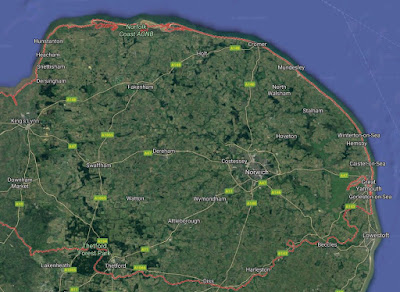
The north coast of Norfolk has been called the British ornithologist's Mecca, with the famed names of Cley, Blakeney, Holkham, Titchwell and Scolt. Here we saw species that can only be seen on the coasts of northern Europe - Herring Gull, Brent Goose, Eider Duck and Gannet.

Resting on islands in the marshes were Avocets (Recurvirostra avosetta). The Avocet has been the logo of the RSPB since 1970 - designed by Cley artist Robert Gillmor.
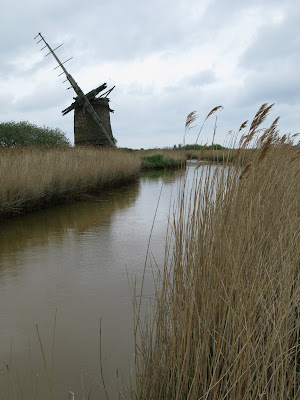
The Norfolk Broads are a wetland of flooded rivers and lakes to the north-west of Norwich, where windmills once tried to drain them. In 1979 four Common Cranes arrived at Hickling Broad, and in 1982 a chick hatched there - the first to do so in Britain for over 400 years. There are now 64 pairs in Britain, and we were lucky enough to see one of these at Hickling.
We visited Buxton Heath, to the north-west of Norwich - full of acid-loving heather and gorse.
Here we saw the aptly named Small Heath butterfly (Coenonympha pamphilus) resting on last year's foliage. Its larvae will feed on grasses.
We saw over 100 species of birds in just a few days - more than we saw in Morroco. Of particular interest were not just the distant northern water birds, but the more common European birds which can be found in gardens - many of those found in Britain are classed as distinct sub-species, being relatively sedentary populations that have evolved independently in island isolation (such as the Great Tit, Greenfinch and Dunnock).

Thanks Steve.