Friday, February 19, 2021

BBC 2014: Southern Israel

March 2014 - a full BBC trip to southern Israel. Starting in Jerusalem, we went east to the Dead Sea then followed the long sides of an isoceles triangle down to Eilat on the Gulf of Aqaba and up to Gaza on the Mediterranean.
Driving through the Judean Desert on the way to the Dead Sea, we stopped whenever we saw anything interesting move in the sparse bushes.
The White-spectacled Bulbul (Pycnonotus xanthopygos) is found in the Levant and Arabia, from Turkey to Oman.
A shiny Palestine Sunbird (Cinnyris osea). It is the nominal sub-species, found in the Levant and Arabia. There is another sub-species in Africa.
We saw what we thought was a strange bird, but it turned out to be a Rock Hayrax (Procavia capensis) - called Coney in the bible. It is the only African mammal also to be found in the Middle East - where it is the sub-species habessinicus. I read they spend 95% of their time resting, as a necessary part of their thermoregulation system (that's they're story anyway). We didn't expect to see any on a menu in Israel, as they are classified in the bible as non-kosher: Leviticus 11:5; "And the coney, because he cheweth the cud, but divideth not the hoof; he is unclean unto you".
We were very proud of ourselves for spotting Nubian Ibex (Capra nubiana), as there are only an estimated 1,200 individuals left in the wild in North Africa and the Middle East. They are now protected in Israel.
We arrived at the Dead Sea, where sheets of salt appeared to float like ice on a winter lake.
On arrival at the Ein Gedi kibbutz, we were surprised to be met by Nubian Ibex grazing on the lawns. It seems they are quite happy to walk in from the mountains of the nature reserve. It shouldn't be a surprise - on mountains in Switzerland their relatives, the Alpine Ibex, will sit on the hiking paths.
They were joined by Sand Partridge (Ammoperdix heyi), a local bird of Egypt, Arabia and the Levant...
... and watched over by another local, Tristram's Starling (Onychognathus tristramii). It is named after the Reverend Henry Baker Tristram, a 19th century English ornithologist from Northumberland who explored the Sahara and the Middle East. He was a founder of the British Ornithologist's Union in 1858, but never fully accepted Darwin's theory which was published the following year. 
In the area we saw Arabian Babler (Argya squamiceps), a real local of Arabia and the Levant. They live in groups, in which only one pair breeds and the others help out - making them a great model for studies on altuism.
I can only think this is a pale Asian Desert Warbler (Curucca nana), now a separate species to the African desert Warbler. It visits Arabia in the winter, and breeds in Central Asia and China.
A Spur-winged Lapwing (Vanellus spinosus) - a bird of Africa, the eastern Mediterranean and Arabia.
Overhead a group of Black Storks (Ciconia nigra), on their way north to breed in Turkey or Europe.
We followed the Jordan Valley south...
...and stopped at the Lotan kibbutz, about 60 km before Eilat.
In this area we saw Spanish Sparrows (Passer hispaniolensis) - similar to House Sparrows, but with black bibs that have spread down their bodies like hair dye in the rain. They were first described by the early 18th century Dutch Zoologist Coenraad Jacob Temminck, from a specimen taken in southern Spain. In 1815 Temminck wrote the standard book on European birds, and spent the rest of his life as director of the Natural History Museum in Leiden. Fourteen species of birds were named after him - as well as fish, reptiles and mammals. Here it is the eastern sub-species P. h. transcaspicus, extending from the Levant to Asia Minor - first described in 1902 by the Austrian ornithologist with the impressive name of Viktor von Tschusi zu Schmidhoffen (whose son became an expert on the birds of the Canary Islands). The western sub-species occurs from Spain to Turkey. 
The 'Black-headed Wagtail', the feldegg sub-species of the Yellow Wagtail (Motacilla flava), which breeds from the Balkans to Afghanistan and overwinters in central Africa.
The Blackstart (Oenanthe melanura) is a desert resident of North Africa, Middle East and Arabia. It was also first described by Coenraad Jacob Temminck, in 1824. This is the nominal sub-species found in the Levant.
The Bluethroat (Luscinia svecica) has a very broad northern distribution from Portugal to Siberia, and over to Alaska - overwintering in North Africa and India. Across its breeding range it is divided into a number of sub-species separated on whether their blue bibs have no spot, a white spot, or a brown spot. This one has a brown spot, and is therefore making its way to either Scandinavia, Russia or Siberia.
Like another great Englishman, T. E. Lawrence 'of Arabia', we made it to the Gulf of Aqaba - to Eilat.
He might still recognise it.
Eilat is in the north Red Sea bottle-neck for birds migrating between Africa and Eurasia, which explains why a concentraion of species can be seen in Israel before they fan out to other parts of the world.
These Spoonbills (Platalea leucorodia) are en route from Africa to Europe.
This Redshank (Tringa totanus) may have spent the winter here, and will soon be flying north.
The Western Reef Heron (Egretta gularis) is not one of the migrants - it is resident, mainly in the tropics, from Africa to Asia. It was first desribed by the French naturalist Louis Augustin Guillaume Bosc in 1792. It has two colour morphs, white and grey, controlled by a single gene - grey being incompletely dominant over white. The sub-species schistacea reaches its northern limit at Eilat. A closely related eastern species resides in the New World.
The Slender-billed Gull (Chroicocephalus genei) is a very local coastal breeder across the Mediterranean and Middle East. It may have overwintered here or be en route from Africa.
Behind the coast we had great views of Green Bee-eaters (Merops orientalis), found from Africa to south-east Asia - here the cyanophrys sub-species.
This gem, with a moustachial stripe that a hussar would be prouf of: Rüppell's Warbler (Curruca ruppeli) - a very local breeder in southern Greece and south-west Turkey, on its way from its wintering ground in north-east Africa. Eduard Rüppell was an 18th century German naturalist, who made expeditions to east Africa and Arabia. He has nine animals named after him.
We left for the Negev Desert, and first stopped at a wadi.
Laughing Doves (Spilopelia senegalensis) walked around with little fear of humans. They are residents of dry scrublands in Africa and the Middle East through to India.
This is a Poekilocerus bufonius grasshopper. They eat poisonous plants of the milkweed family, which in turn makes them poisonous to predators.
We picked up Israeli birder Itai Shanni from his home in the Negev, and he took us out into the cold dawn of the desert.
As the sun and the temperature rose, all around us White Storks (Ciconia ciconia) took to the air. We watched them wheel up into the sky and fly off north.
These Red-throated Pipits (Anthus cervinus) may have spent the winter in Israel, but they need to move much further north to reach their summer breeding grounds in the arctic.
This Blue-cheeked Bee-eater (Merops persicus) has nearly reached the end of its migration, from tropical Africa to the Middle East. It probably eats more dragonflies than bees.
Overhead a Long-legged Buzzard (Buteo rufinus), a resident of Israel.
The Desert Agama (Trapelus mutabilis) is found in deserts from Morocco to Arabia.
The White Widow spider (Latrodectus pallidus) is in the same genus as the famous Black Widow spider, and is also venomous. It is found in deserts from Morocco to Central Asia, and has even reached the fame of appearing on a stamp in Kazakhstan.
We followed the road along the border with Egypt.
We passed a group of young Nubian Ibex.
The Sparrowhawk (Accipiter nisus) is here at the southern edge of its breeding area.
Slowly, as we headed north out of the desert, the land became greener, and other species appeared. A Hoopoe (Upupa epops), resident at the southernmost point of its distribution. Its English and latin names are onomatopoeic, imitating the bird's call.
The Chukar (Alectoris chukar) is resident from Turkey to the far east - here the cypriotes sub-species.
The Hooded Crow (Corvus cornix) meets and hybridizes with the Carrion Crow at a line running through Europe, and reaches its southern limit in Israel and Egypt as the C. c. pallescens sub-species.
This Masked Shrike (Lanius nubicus) has returned to Israel after wintering in Africa. It was first described by the German naturalist Martin Hinrich Carl Lichtenstein in 1823, just one year before an independent description by Coenraad Jacob Temminck. Lanius means 'butcher' in latin. It comes from the habit of shrikes of impaling their insect prey on plant thorns - though they will also use barbed wire, of which there is no shortage on the Israeli border.
We finally reached the coast at Gaza, but decided it would be prudent just to observe the city across the fields rather than to enter it. Two days before, over 60 rockets had been fired into this area from the city. Four months after we left a seven week long war broke out in which almost 4,000 rockets were fired by Hamas, and Gaza was bombarded and invaded by Israeli forces. Over 2,000 people were killed, and over 10,000 wounded - mostly civilians.
We saw over 120 species of birds in Israel, with many other species of local interest. Winter visitors heading north to breed in more remote areas of Europe included Cyprus Warbler, Pallid Harrier and Marsh Sandpiper; A summer arrival to the Middle East and Asia Minor: Isabelline Wheatear; and species that are resident throughout Africa, Arabia and the Middle East - and a in few cases as far as India and China: Hooded Wheatear, White-crowned Wheatear, Desert Wheatear, Blackstart, Streaked Scrub Warbler, Graceful Prinia, Clamorous Reed Warbler, Brown-necked Raven, Fan-tailed Raven, House Crow, Pale Rockfinch, Barbary Falcon, Crowned Sandgrouse, Lichtenstein's Sandgrouse, White-throated Kingfisher, Pied Kingfisher and Pale Crag Martin.

BBC - birds without borders.

Friday, February 12, 2021

BBC 2013: Estonia

A 2012 BBC trip failed to materialise, but by May 2013 a full team had been assembled to go to Estonia - the most northerly of the Baltic states, further north than Scotland. We toured the south of the country, towards the borders with Latvia and Russia.
Starting on the coast, we saw a small group of Red-necked Grebes (Podiceps grisegena). They have a global distribution: one sub-species extends from eastern Europe to Russia and the far east, the other is found in the north of America. The joy of them is when, in summer, they turn from a dull grey to sport a bright red neck.
A White-tailed Eagle (Haliaeetus albicilla) flew over the sea in search of fish or water birds. They are happy fishing in northern waters, from the Baltic to Japan, though they do go to southern Asia to escape the Siberian winters. They were shot and poisoned to extinction in Britain by 1916 - but there is now a sucessful reintroduction programme. They are big fearsome birds, with a wingspan that can reach almost 2.5 metres and with a bill almost half of the head.
Into the woods, and we found an active nest of the White-backed Woodpecker (Dendrocopos leucotos). They were first described in 1802 by the German naturalist Johann Matthäus Bechstein - an early conservationist - and can be found from eastern Europe through to Japan. We had very close views of a male going out to collect food and bringing it back to the chicks.
The male of a Common Rosefinch (Carpodacus erythrinus) is only rivalled for redness in Europe by the Crossbills. We think of them as birds of north-east Europe - but they occur as far east as Japan, and as far south as India and south-east Asia.
When Rosefinches are caught in a certain light, they can positively glow.
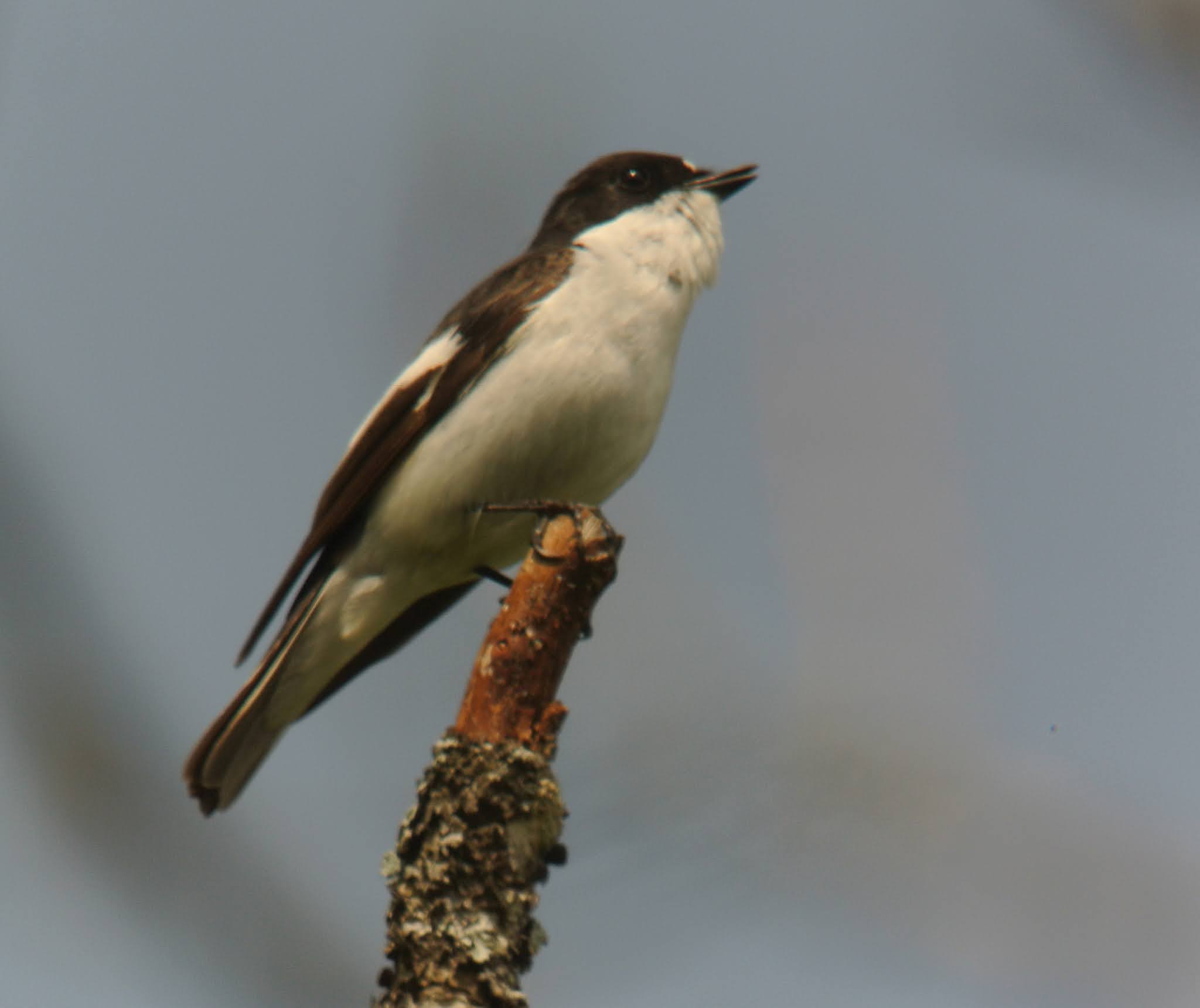
The Pied Flycatcher (Ficedula hypoleuca) is really a European species, though it spends its winters in West Africa. They have been studied a lot due to the males' habit of bigamy. They may set up two nests with consecutive females, but only look after the nest of the first - and the second females will only rear half the number of offspring due to this neglect. Why the second females accept this is unclear - it may be that the fewer males they rear inherit the advantagous mate finding genes of their fathers, or the females compete for mates and settle for what they can get; or the females are simply deceived. Whatever, ornithologists are advised not to try this at home!
Warblers are often called by birders LBJs ('little brown jobs'). They often lack the bright colours of other birds, and may be difficult to see as they skulk around in foliage like little mice. And species are often difficult to tell apart. This is a Whitethroat (Sylvia communis), an LBJ with a WT. Sylvia warblers are usually sturdy, the males with contrasting dark heads, and they prefer to live in dense thickets.
Phylloscopus warblers are often tinged with green and yellow with a pale supercilium ('eyebrow'), and will flit about trees and sit on their tops. I think this is a Willow Warbler (Phylloscopus trochilus). It is very similar to the Chiffchaff, but has paler legs. 
This also looks like a Willow Warbler, but it is darker in body and legs. There is a hint of a pale bar on its side, which could make it a Greenish Warbler (Phylloscopus trochiloides) - but it is only a hint. So it is most probably a Chiffchaff  (Phylloscopus collybita) of the abietinus sub-species, found in Scandinavia and Russia.
In the reeds a Sedge Warbler (Acrocephalus schoenobaenus). Acrocephalus warblers may also have pale 'eyebrows', but they have a more pointed shape and live in marshlands.
The Marsh Warbler (Acrocephalus palustris) looks very similar to the Reed Warbler - though it tends to have paler legs, and prefers woody plants to reeds.
Birding is not just about looking, and most people's experience of birds is listening to them sing. Warblers are great singers, and their song can be used to identify them when a good view is not possible. All the above warblers are migratory, spending the winter in Africa - and one of the joys of Spring is listening to them sing again on their return. I'll leave you with our Estonian Marsh Warbler singing in the midst of a chorus of song. He has a different call to the similar Reed Warbler - but is also known to copy the songs of other species. LBJs - never easy!
We saw around 100 species of birds in Estonia. Some actic breeders  - such as the Great Snipe, Redwings, Whooper Swans, Golden Plovers and Greenish Warblers - had reached their most southerly breeding sites after migration. That included Arctic Terns, which spend the rest of the year circumnavigating the globe. Others, such as the Barnacle Geese and White-fronted Geese, were just pausing on their way further north.

BBC - still listening after all these years. Terviseks!