Friday, February 12, 2021

BBC 2013: Estonia

A 2012 BBC trip failed to materialise, but by May 2013 a full team had been assembled to go to Estonia - the most northerly of the Baltic states, further north than Scotland. We toured the south of the country, towards the borders with Latvia and Russia.
Starting on the coast, we saw a small group of Red-necked Grebes (Podiceps grisegena). They have a global distribution: one sub-species extends from eastern Europe to Russia and the far east, the other is found in the north of America. The joy of them is when, in summer, they turn from a dull grey to sport a bright red neck.
A White-tailed Eagle (Haliaeetus albicilla) flew over the sea in search of fish or water birds. They are happy fishing in northern waters, from the Baltic to Japan, though they do go to southern Asia to escape the Siberian winters. They were shot and poisoned to extinction in Britain by 1916 - but there is now a sucessful reintroduction programme. They are big fearsome birds, with a wingspan that can reach almost 2.5 metres and with a bill almost half of the head.
Into the woods, and we found an active nest of the White-backed Woodpecker (Dendrocopos leucotos). They were first described in 1802 by the German naturalist Johann Matthäus Bechstein - an early conservationist - and can be found from eastern Europe through to Japan. We had very close views of a male going out to collect food and bringing it back to the chicks.
The male of a Common Rosefinch (Carpodacus erythrinus) is only rivalled for redness in Europe by the Crossbills. We think of them as birds of north-east Europe - but they occur as far east as Japan, and as far south as India and south-east Asia.
When Rosefinches are caught in a certain light, they can positively glow.
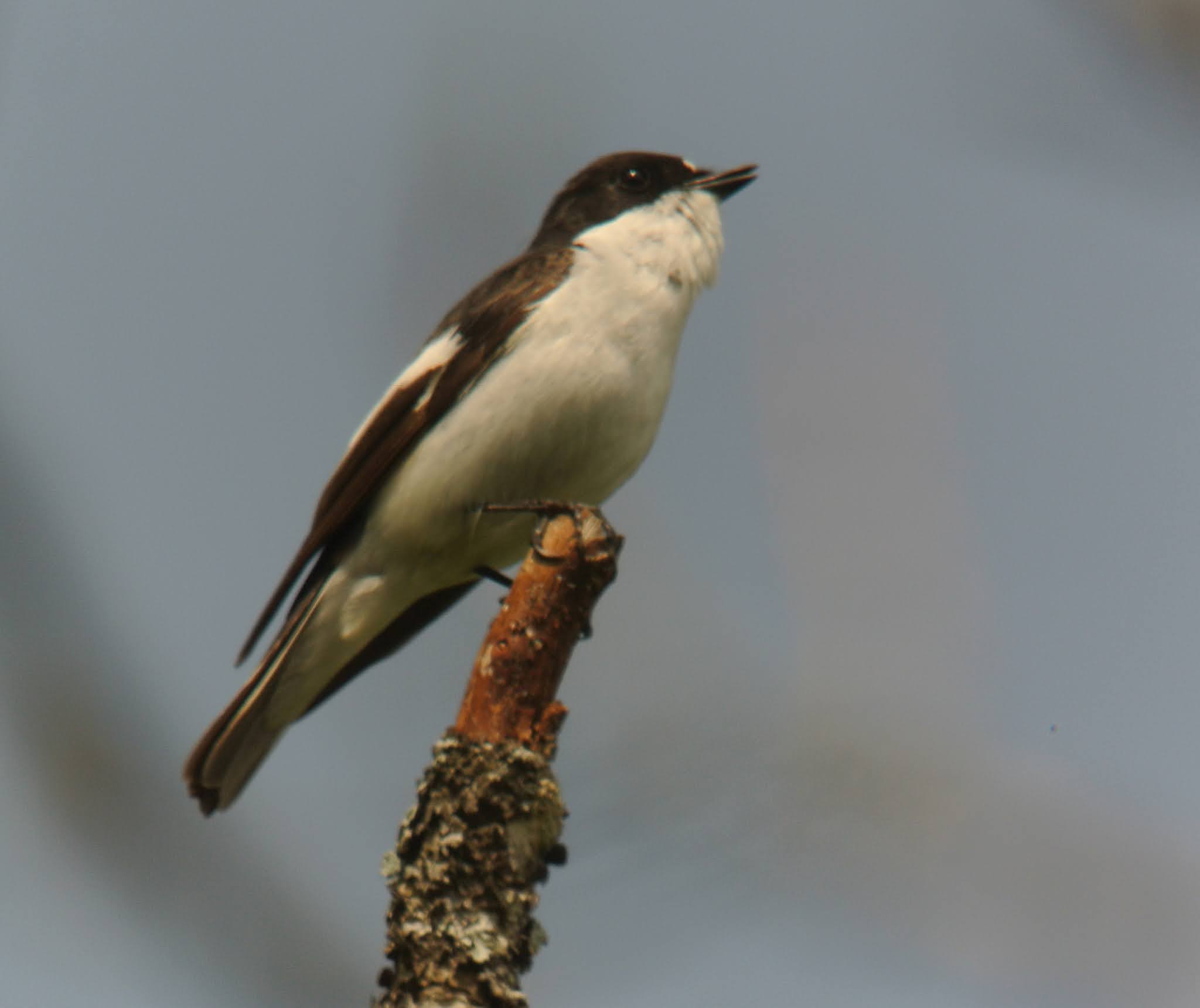
The Pied Flycatcher (Ficedula hypoleuca) is really a European species, though it spends its winters in West Africa. They have been studied a lot due to the males' habit of bigamy. They may set up two nests with consecutive females, but only look after the nest of the first - and the second females will only rear half the number of offspring due to this neglect. Why the second females accept this is unclear - it may be that the fewer males they rear inherit the advantagous mate finding genes of their fathers, or the females compete for mates and settle for what they can get; or the females are simply deceived. Whatever, ornithologists are advised not to try this at home!
Warblers are often called by birders LBJs ('little brown jobs'). They often lack the bright colours of other birds, and may be difficult to see as they skulk around in foliage like little mice. And species are often difficult to tell apart. This is a Whitethroat (Sylvia communis), an LBJ with a WT. Sylvia warblers are usually sturdy, the males with contrasting dark heads, and they prefer to live in dense thickets.
Phylloscopus warblers are often tinged with green and yellow with a pale supercilium ('eyebrow'), and will flit about trees and sit on their tops. I think this is a Willow Warbler (Phylloscopus trochilus). It is very similar to the Chiffchaff, but has paler legs. 
This also looks like a Willow Warbler, but it is darker in body and legs. There is a hint of a pale bar on its side, which could make it a Greenish Warbler (Phylloscopus trochiloides) - but it is only a hint. So it is most probably a Chiffchaff  (Phylloscopus collybita) of the abietinus sub-species, found in Scandinavia and Russia.
In the reeds a Sedge Warbler (Acrocephalus schoenobaenus). Acrocephalus warblers may also have pale 'eyebrows', but they have a more pointed shape and live in marshlands.
The Marsh Warbler (Acrocephalus palustris) looks very similar to the Reed Warbler - though it tends to have paler legs, and prefers woody plants to reeds.
Birding is not just about looking, and most people's experience of birds is listening to them sing. Warblers are great singers, and their song can be used to identify them when a good view is not possible. All the above warblers are migratory, spending the winter in Africa - and one of the joys of Spring is listening to them sing again on their return. I'll leave you with our Estonian Marsh Warbler singing in the midst of a chorus of song. He has a different call to the similar Reed Warbler - but is also known to copy the songs of other species. LBJs - never easy!
We saw around 100 species of birds in Estonia. Some actic breeders  - such as the Great Snipe, Redwings, Whooper Swans, Golden Plovers and Greenish Warblers - had reached their most southerly breeding sites after migration. That included Arctic Terns, which spend the rest of the year circumnavigating the globe. Others, such as the Barnacle Geese and White-fronted Geese, were just pausing on their way further north.

BBC - still listening after all these years. Terviseks!

Tuesday, February 9, 2021

BBC 2011: Lesbos

By the end of May 2011 Steve was back in the fold, but Dick was still dragging his feet - so we had a three-quarters full BBC trip to the Greek island of Lesbos off the coast of Turkey. 
The Greek philosopher Aristotle landed here in 345BC, and began collecting and studying sea life in the central lagoon - then known as the euripus of Pyrrha. He stayed for two years, in which time and he made anatomical analyses to classify organisms and to explain how they functioned and reproduced - which he recorded in many books. His conclusions were mostly wrong and, despite observing variation in organisms, he believed life was immutable (though not created by a god). However, he could claim the title of the world's first biologist - and he initiated scientific methodology by expounding the need to observe, examine and hypothesize to understand the world.
The lagoon is still there, hosting a flock of flamingos, but it is now called the Kalloni Gulf.
Sea life is still abundant.
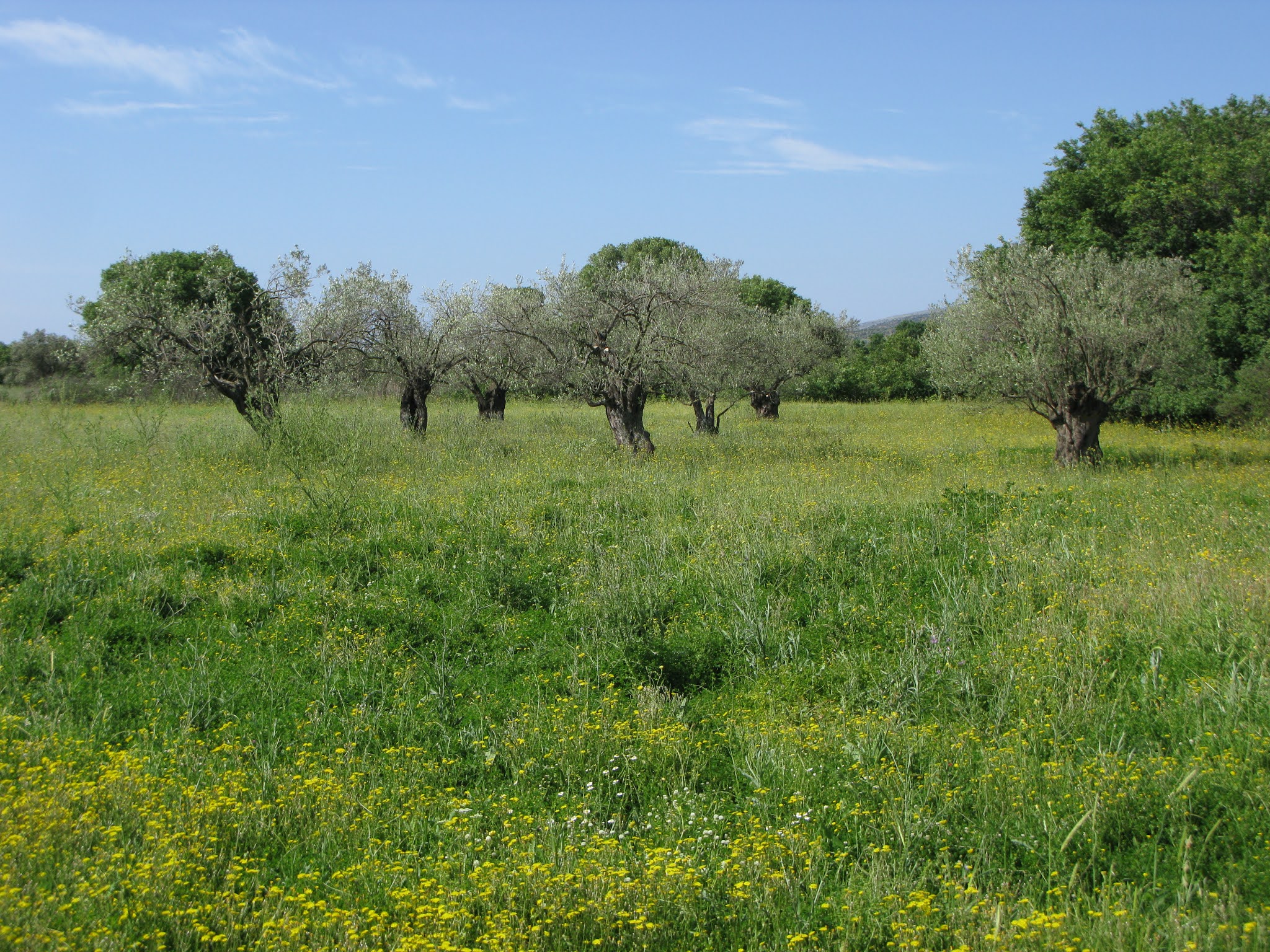
Greece is often associated with arid landscapes - as most tourists visit the south in the height of the hot summer - but Lesbos in Spring is a verdant paradise, alive with brightly coloured flowers and running water.
This may look like the flower of a tree, but it is a group of Thaumetopoea solitaria moth caterpillars - first described in 1838 by the German entomologist Christian Friedrich Freyer. They clump together, forming a furry mass with their long white hairs. They are mainly found in Turkey and the Middle East, where they feed on Pistacia trees - on Lesbos it is P. atlantica (the Mt. Atlas Mastic, Persian Turpentine or Wild Pistachio Tree) which occurs from North Africa to Iran. (The Pistachio nut tree from Central Asia and the Middle East is P. vera).
Fresh water and plants may not attract tourists, but they provide great habitats for other animals. A Western Yellow Wagtail (Motacilla flava) patrols the shore - it is the feldegg sub-species, the Black-headed Wagtail, which breeds from the Balkans to Afghanistan.
A Black Stork (Ciconia nigra), back from winter migration to central Africa, searches for fish.
The elegant Wood Sandpiper (Tringa glareola), on its way from Africa to the sub-arctic wetlands to breed. Tringa is a latin version of the Ancient Greek 'Tungas' - as mentioned by Aristotle.
And a truly spectacular sight - a flock of Curlew Sandpipers (Calidris ferruginea). They too are on Spring migration, but hear this: they breed in the arctic circle, in the far north of Siberia, but may spend the winter as far south as South Africa or even Tasmania! As if that wasn't enough, in the breeding season their plumage changes from a light grey to a deep red - and here you can see they already in that transition.
Cretzschmar's Bunting (Emberiza caesia) breeds from Greece to the Levant, and overwinters in the Sudan. It is named after the German physician and scientist Philipp Jakob Cretzschmar, who founded the Senckenberg Natural History Society in Frankfurt in 1817 - now the second largest natural history museum in Germany.
We searched the woodlands of Turkish pines (Pinus brutia) for Krüper's Nuthatch (Sitta krueperi), and were successful. It is found in Turkey and through the Caucasus to Russia. It was named at the end of the 19th century by the Austrian ornithologist August von Pelzeln after the German naturalist Theodor Johannes Krüper, who became curator of the zoological collection of the natural history museum in Athens.
Obligingly posing by the roadside, an Eastern Black-eared Wheatear (Oenanthe melanoleuca), now separated from the Western Black-eared Wheatear (O. hispanica) - the two meeting in central Italy.
Also using a man-made structure as a perch, a Little Owl (Athene noctua).
But the prize owl was this Scops Owl (Otus scops), suspiciously eying us from the safety of its tree roost in a car park - it is not surprising that skopos is Ancient Greek for 'watcher'.
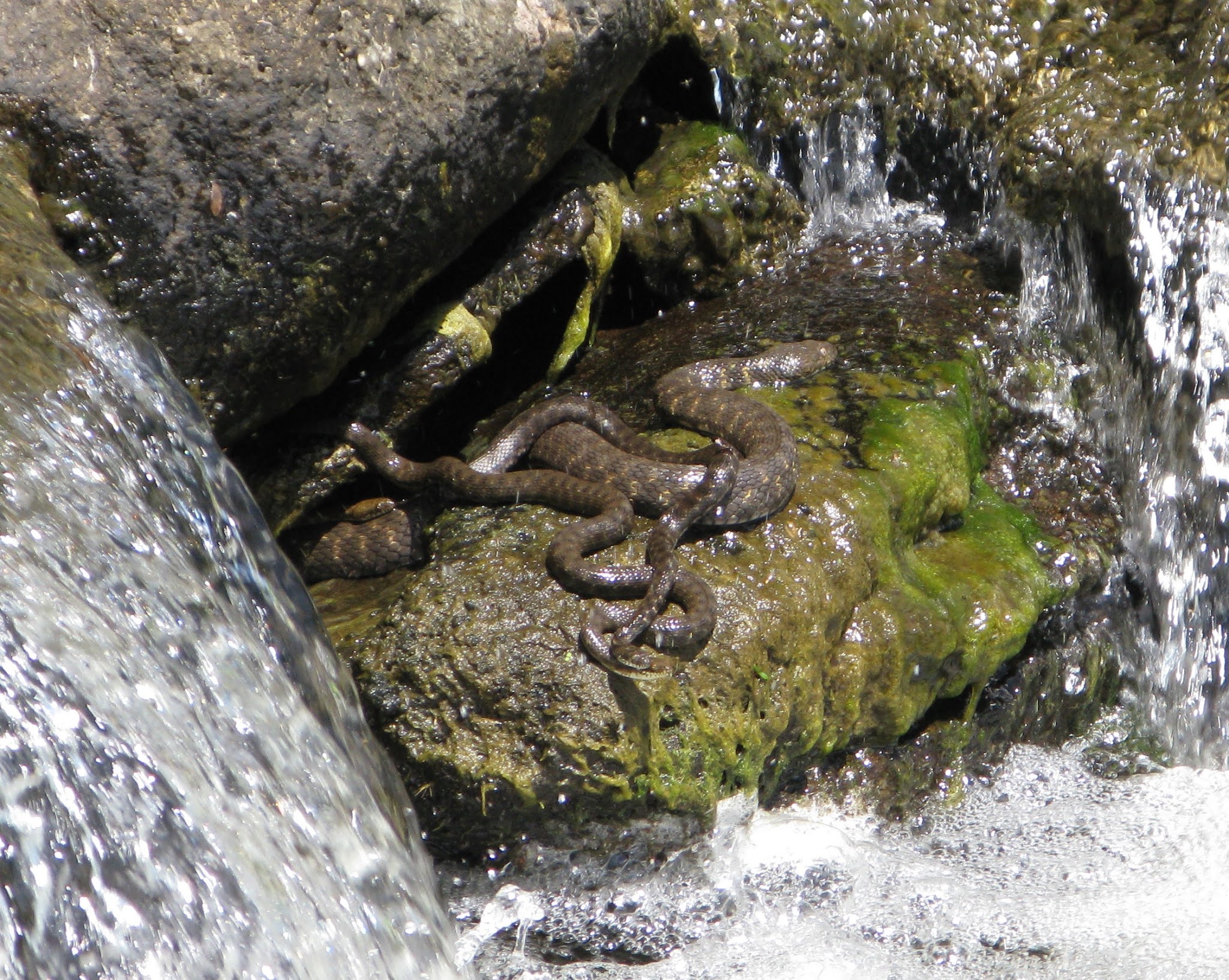
Also enjoying the Spring water, four Dice Snakes (Natrix tessellata) - otherwise known as Tessellated Water Snakes - which have found a perfect platform to hang out on as a base to hunt for fish. They are found from Italy to Central Asia.
This Sheltopusik (Pseudopus apodus) - or Glass Lizard - also found from Italy to Central Asia, was less lucky when out on the open road. Its name comes from the Russian for 'yellow-bellied'.
Another reptile happy in water is the Caspian Turtle (Mauremys caspica), found from the Balkans to central Asia. This is the sub-species M. c. rivulata, the Western Caspian Turtle. The young will need to watch out for the Black Storks!
The landlubber cousin of the turtle is the Greek or Spur-thighed Tortoise (Testudo graeca), found all over the Mediterranean along with four other species of tortoise. They live for much longer than humans, and it is highly likely that there are tortoises on Lesbos which were alive to see it under Turkish rule at the beginning of the 20th century. Indeed, they belong to the Turkish sub-species T. g. ibera.
Most lizards are not so dependent on water. This is a Snake-eyed Lizard (Ophisops elegans), found from the Mediterranean to Central Asia. The sub-species on Lesbos is O. e. ehrenbergi.
This immature Balkan Green Lizard (Lacerta trilineata), as the name suggests, has three beautiful green stripes on its back. Yet the adults are even more impreesive, being bright green with bright blue cheeks. It is found from the Balkans to the Middle East.
Starred Agamas (Stellagama stellio) can commonly be seen sitting on top of rocks from Greece to the Middle East. 
And when back in our rooms after sunset, Mediterranean House Geckos (Hemidactylus turcicus) kept us company. 
My blogs may give the impression that birding is fun and easy - that you just walk around, and species appear in front of you. This is not the case, and often we have to spend hours patiently looking out to sea in the hope of seeing a bird fly across the water.
We saw around 80 species of birds on Lesbos. Other birds of note were those which are mainly found in the eastern Mediterranean: Yelkouan Shearwater, Eleonoras's Falcon, Masked Shrike, Olive-tree Warbler and Eastern sub-alpine Warbler.

BBC - walking in the footsteps of giants.